

Table of Contents
 Unit I: Some Data and Facts about Philippine Agriculture
 Unit I: Some Data and Facts about Philippine Agriculture
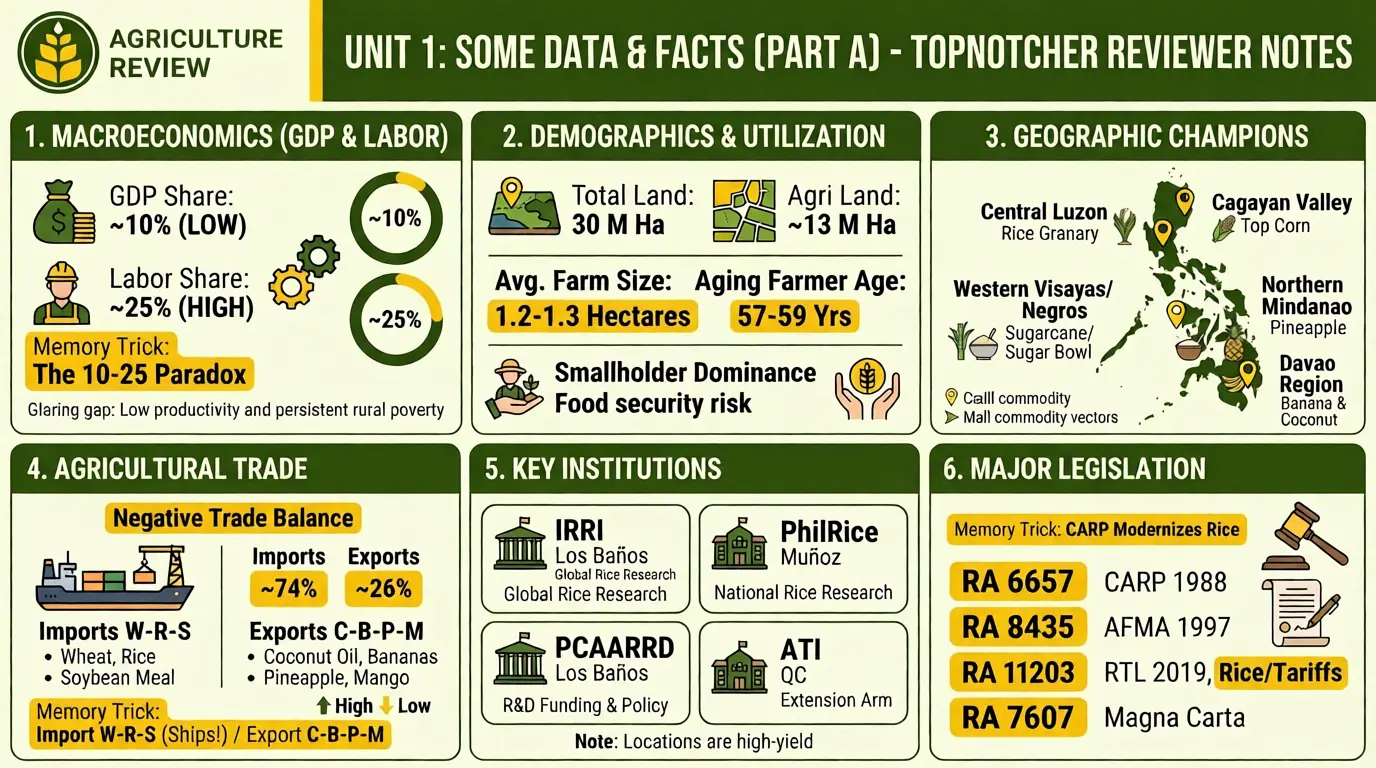
Welcome to Part A of the Topnotcher Reviewer Module. The Professional Regulation Commission (PRC) relies heavily on updated structural data, land utilization statistics, and major legislative milestones to test a candidate’s grasp of the industry’s landscape. Memorize these verified facts, metrics, and regional rankings to secure sure points on the board exam.
📈 1. The Macroeconomic & Labor Snapshot
To understand agricultural policies, you must first understand the sector’s economic output relative to its workforce. This disproportion is a favorite PRC LEA exam topic.
When asked for the macroeconomic share of Philippine agriculture, recall the numbers 10 and 25:
- GDP Contribution: Agriculture contributes roughly 9% to 10% to the National Gross Domestic Product.
- Labor Force: Yet, it employs roughly 24% to 25% of all Filipino workers.
- Examiner’s Insight: This massive gap illustrates low agricultural productivity and economies of scale issues, explaining the persistent rural poverty in the country.
🌍 2. Land Utilization & Farm Demographics
The physical geography of Philippine agriculture heavily influences government interventions, mechanization efforts, and agrarian reform.
🏆 3. Regional Agricultural Champions
Examiners love matching crops to their top-producing regions. Memorize these distinct geographic leaders based on PSA data:
- Central Luzon (Region III): The “Rice Granary of the Philippines.” Top producer of Palay.
- Cagayan Valley (Region II): The undisputed top producer of Corn.
- Davao Region (Region XI): The top producer of Bananas and Coconuts.
- Western Visayas (Region VI): Specifically Negros Occidental, the “Sugar Bowl” and top sugarcane producer.
- Northern Mindanao (Region X): Top producer of Pineapples (Bukidnon area).
⚖️ 4. Major Agricultural Laws (Republic Acts)
Policy questions are guaranteed in the LEA. Use this mnemonic to lock down the Republic Act numbers.
- RA 6657: Comprehensive Agrarian Reform Program (CARP) – 1988.
- RA 8435: Agriculture and Fisheries Modernization Act (AFMA) – 1997.
- RA 11203: Rice Tariffication Law (RTL) – 2019 (Replaced quantitative restrictions on rice imports with tariffs).
- RA 7607: Magna Carta for Small Farmers.
🚢 5. Agricultural Trade (Exports vs. Imports)
The Philippines operates on a negative agricultural trade balance (we import more than we export). The PRC board frequently tests your knowledge of our top dollar-earning commodities versus the major staples we are forced to buy from other countries.
- Exports (C-B-P-M): Coconut, Banana, Pineapple, Mango.
- Imports (W-R-S): We Rely on Ships! (Wheat, Rice, Soybeans).
🏛️ 6. Key Agricultural Institutions & Agencies
Matching the correct agricultural institution to its mandate and exact location is a guaranteed question format in the board exam. Memorize the locations specifically, as examiners often use them as distractors.
Mandate: Global rice science & poverty reduction.
Mandate: National rice self-sufficiency.
Mandate: Formulate national R&D frameworks.
Mandate: The extension and training arm of the DA.
💡 Master Interactive Reviewer: Topnotcher Flashcards
Test your overall retention! Hover (or tap on mobile) to flip the cards and reveal the answers. These specific metrics and facts appear frequently in actual LEA exams.




hi ma’am/sir thank you for the update and reviewer, I wish I can pass the exam, if ever that happen I owe you for ever, thank you so much for everything,
Welcome Agriculturist, I wish to see your name in the PASSER List, All The Best!!