
Table of Contents
 Unit I – Part B: Problems, Status, & Prospects
 Unit I – Part B: Problems, Status, & Prospects
Before implementing any crop science technique, an agriculturist must understand the systemic challenges hindering the sector. The PRC board exam consistently tests a candidate’s grasp of national policies designed to solve these problems, particularly trade agreements and technological interventions.
⚠️ The 4 Core Problems of Philippine Agriculture
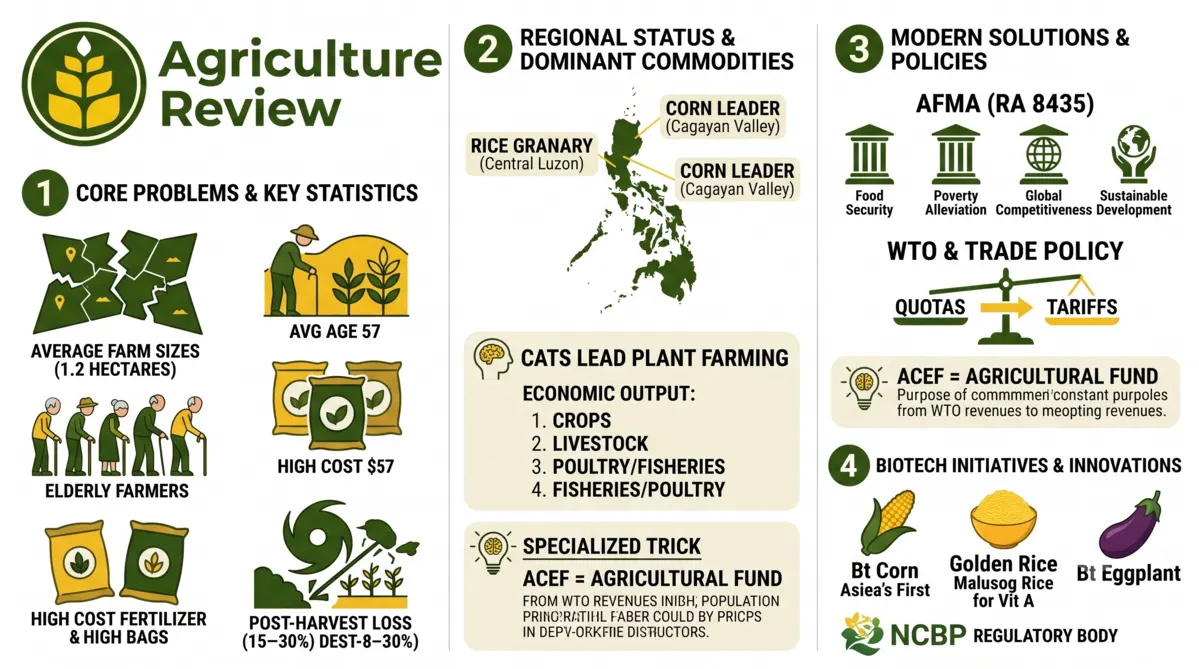
According to current institutional assessments, the Philippine agricultural sector is bottlenecked by four primary issues:
- Smallholder Fragmentation: With an average farm size of 1.2 to 1.3 hectares, economies of scale and widespread mechanization are nearly impossible to achieve efficiently.
- Aging Workforce: The average Filipino farmer is 57-59 years old. The youth are migrating to urban centers, posing a severe threat to future food security.
- High Cost of Inputs: Heavy reliance on imported fertilizers (urea, potash) and fuel drastically lowers the farmer’s net profit margin.
- Climate Vulnerability: The country experiences an average of 20 typhoons annually, causing billions in crop damages, particularly in the rice and corn sectors.
📜 1. AFMA: The Agriculture and Fisheries Modernization Act
Enacted as Republic Act No. 8435 in 1997, AFMA is the blueprint for transforming the agricultural sector from resource-based to technology-based. It is the most frequently tested law in the LEA.
Memorize the core objectives of AFMA to easily answer situational board questions:
- Food Security (Availability and affordability of food).
- Poverty Alleviation and Social Equity.
- Global Competitiveness (Producing export-quality goods).
- Sustainable Development (Protecting resources for future generations).
Highly Testable Concept: SAFDZ
SAFDZ stands for Strategic Agriculture and Fisheries Development Zones. Under AFMA, these are specific geographic areas identified for optimal production, agro-processing, and marketing activities to ensure maximum efficiency of government funding and minimize resource waste.
🌐 2. GATT & WTO: Global Trade Implications
The General Agreement on Tariffs and Trade (GATT) was the predecessor to the World Trade Organization (WTO). The Philippines joined the WTO in 1995, shifting the country toward trade liberalization and changing how we protect local farmers.
🧬 3. Biotechnology: Scientific Interventions
Biotechnology, specifically the use of Genetically Modified Organisms (GMOs), is the prime scientific strategy to increase yield per hectare and withstand pests without needing to expand agricultural land area.
Key Biotech Milestones for the Board Exam
- The Pioneer Crop: The Philippines was the first country in Asia to approve a genetically modified crop for commercialization: Bt Corn (approved in 2002).
- How it works: “Bt” stands for Bacillus thuringiensis, a naturally occurring soil bacterium. The gene inserted into the corn makes it resistant to the deadly Asian Corn Borer pest.
- Golden Rice (Malusog Rice): Biofortified rice designed to produce Beta-carotene (a precursor to Vitamin A) to combat childhood blindness (Vitamin A Deficiency).
- Bt Eggplant: Engineered to resist the Eggplant Fruit and Shoot Borer (EFSB), drastically reducing the need for heavy, toxic pesticide spraying by farmers.
💡 Master Interactive Reviewer: Topnotcher Flashcards
Test your retention on AFMA, WTO, and Biotech! Tap or hover to flip.