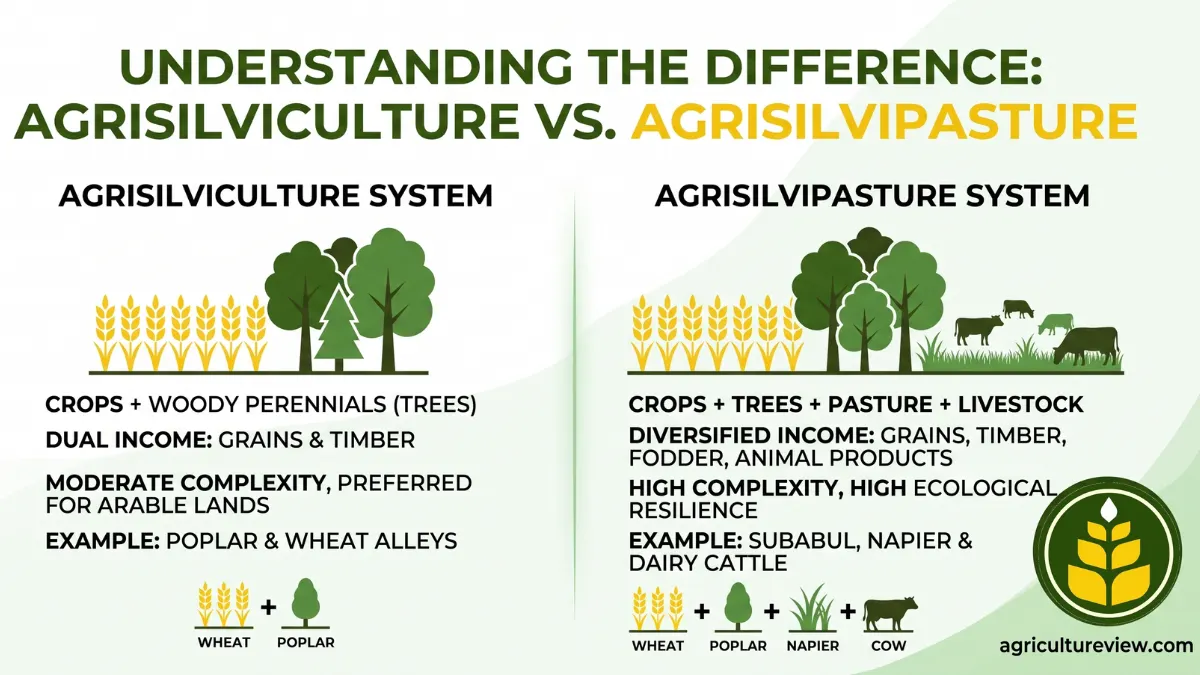
Agrisilviculture is the system in which agricultural crops are intercropped with tree crops in the interspace between the trees, while the agrisilvipasture system is the system in which woody perennials are cultivated combined with annuals and pastures.
Difference Between Agrisilviculture And Agrisilvipasture System
| Feature | Agrisilviculture System | Agrisilvipasture System |
|---|---|---|
| 1. Meaning | Concurrent integration of agricultural crops and forest trees on the same unit of land. | Simultaneous integration of agricultural crops, forest trees, and pasture/livestock on the same unit of land. |
| 2. Components | Two active biological components: Crops + Woody Perennials (Trees). | Three active biological components: Crops + Trees + Pasture/Livestock. |
| 3. Primary Focus | Optimizing yield of food grains and timber/fuelwood while preventing soil degradation. | Holistic fulfillment of food, fodder, fuel, and timber needs while supporting animal husbandry. |
| 4. System Complexity | Relatively lower complexity; requires managing bi-directional plant-tree interactions. | Highly complex; requires managing multi-trophic interactions (plant-tree-animal-soil). |
| 5. Nutrient Cycling | Relies on natural plant-to-soil cycling (leaf litter fall, crop residues). | Accelerated and enriched nutrient cycling due to the addition of animal dung and urine. |
| 6. Land Suitability | Preferred for arable lands and moderately degraded soils where crop cultivation is viable. | Highly suited for marginal, sloping, or degraded lands where pure crop cultivation is economically risky. |
| 7. Economic Security | Dual income streams: Short-term (annual crops) and long-term (timber). | Continuous and highly diversified income (crops + timber + daily/weekly livestock products like milk/meat). |
| 8. Ecological Impact | Improves microclimate, acts as a windbreak, and moderates soil erosion. | Superior ecological resilience; grasses provide continuous ground cover, heavily reducing soil/water runoff. |
| 9. Resource Competition | Competition for light, water, and nutrients is managed through canopy pruning and spatial geometry. | Intense spatial and temporal competition; requires strict grazing management (rotational grazing) to prevent overgrazing. |
| 10. Examples | Growing Wheat or Mustard in the alleys of Poplar trees; Teak intercropped with Maize. | Subabul (tree) + Sorghum (crop) + Napier grass (pasture) supporting dairy cattle. |
Suitable Examples Of Component Crops
A component crop (intercrop) is a multiple cropping practice involving growing two or more crops in proximity. One of the most prominent examples of crop combinations are the three sisters: maize, beans, and squash; sugarcane and potato; pearl millet and cowpea, etc.
Join Our Massive Agricultural Community!
Connect with thousands of others for updates, study guides, and daily discussions.
👥 272K+ Group Members
👍 22K+ FB Followers
📸 2K+ IG Followers
📢 1,600+ Channel Members