
Have you ever looked at a vast stretch of green fields and thought, “I wish I owned a piece of that”? It’s not just a romantic “back to nature” whim anymore. Nowadays, everyone from tech billionaires to retirees is looking at investing in agricultural land.
Why? Because while the stock market is busy having a heart attack over every tweet or interest rate hike, farmland just… grows. People always need to eat, right? As global food demand sky-rockets with the population, agriculture investment has become one of the most stable ways to diversify your portfolio.
If you’re wondering how to start a farm, or more likely, how to profit from one without actually getting mud on your boots, this guide is for you.
Table of Contents
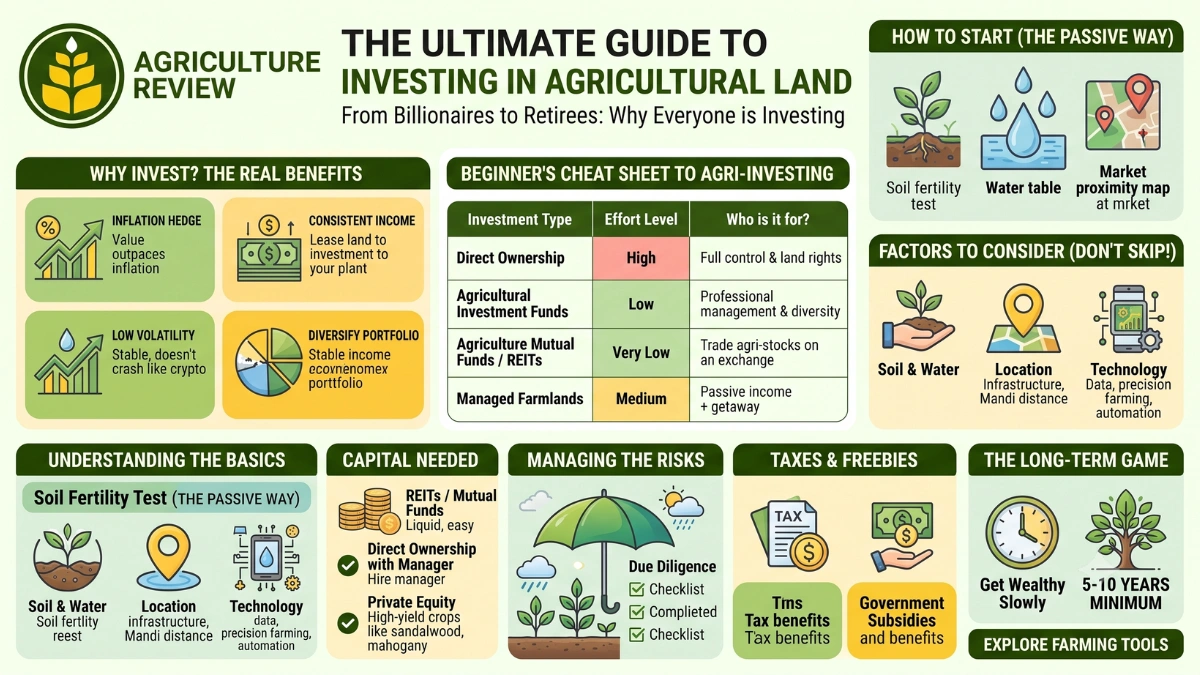
The Beginner’s Cheat Sheet to Agri-Investing
| Investment Type | Effort Level | Who is it for? |
|---|---|---|
| Direct Ownership | High | Those who want full control and land rights. |
| Agricultural Investment Funds | Low | Investors looking for professional management and diversity. |
| Agriculture Mutual Funds / REITs | Very Low | People who want to trade agri-stocks on an exchange. |
| Managed Farmlands | Medium | The “weekend farmer” who wants passive income + a getaway. |
Understanding the Basics: It’s More Than Just Dirt
Before you dive into how to start a farming business, you’ve got to understand that farmland isn’t like a typical apartment rental. You aren’t just looking at square footage; you’re looking at soil fertility, water tables, and “market proximity.”
If the soil is “tired” or the climate is changing too fast, your returns will dry up faster than a pond in May. You need to familiarize yourself with crop cycles and how international trade affects the price of, say, corn or soy. It sounds complex, but once you get the hang of it, it’s a very logical, tangible asset.
The Real Benefits (Why Bother?)
Most people jump into agriculture investment for three main reasons:
- Inflation Hedge: Historically, farmland value outpaces inflation. It’s a “real” asset.
- Consistent Income: You can lease your land to local farmers. You get the rent; they do the hard work.
- Low Volatility: Farmland doesn’t crash 20% in a day like crypto or tech stocks.
The Big Question: The Capital Needed in Farming
Farming isn’t exactly a “zero-down” investment. The capital needed in farming can be quite substantial if you’re buying land outright. You have the land cost, property taxes, and if you’re actually running the show, the cost of seeds, fertilizers, and machinery.
If the upfront cost of buying 50 acres feels like too much, don’t worry. You don’t have to buy the whole tractor. Many people now use agricultural investment funds to pool their money with others. This lets you own a “share” of a massive, professionally managed plantation for a fraction of the price.
How to Start a Farming Business (The Passive Way)
If you aren’t ready to quit your day job in Bangalore or Mumbai, you can still figure out how to start a farm through a managed model.
- Direct Ownership: You buy the land and hire a “Company” or a “Sharecropper” to manage it.
- REITs and Agriculture Mutual Funds: This is the easiest entry point. You invest in companies that own the land or the technology. It’s liquid, meaning you can sell your shares whenever you want.
- Private Equity: Often found in agricultural investment funds, where experts pick high-yield crops (like sandalwood or mahogany) and manage the long-term growth for you.
Factors to Consider (Don’t Skip This!)
I’ve seen people buy “cheap” land only to realize there’s no water access. Big mistake. Huge!
- Soil and Water: Always get a soil test. Fertile soil = higher rent.
- Location: Is there a road? How far is the nearest Mandi or processing plant? Infrastructure defines your ROI.
- Technology: Modern farming is all about data. If you’re investing in agricultural land, look for areas where precision farming and automated machinery are being used. It optimizes yields and cuts costs.
Managing the Risks
I’m not going to sugarcoat it, mother nature can be a bit of a “wildcard.” Droughts, floods, and pests are real risks. This is why “due diligence” is your best friend. Check the land records, verify the zoning regulations (you don’t want to find out later you can’t farm on your “farm”), and look at 10-year weather patterns.
Taxes and “Freebies”
One of the “hidden” perks of an agriculture investment in many places (including India) is the tax benefit. Agricultural income is often exempt from certain taxes, and governments sometimes offer subsidies for sustainable practices or water-saving tech. It’s worth hiring a legal advisor who knows the local “Agri-codes” to save you a ton of money.
Long Term is the Only Term
If you’re looking for a “get rich quick” scheme, go buy a lottery ticket. Farmland is a “get wealthy slowly” game. It requires a long-term strategy, think 5 to 10 years at a minimum.
Whether you are looking at agriculture mutual funds for a hands-off approach or researching how to start a farm from scratch, the goal is the same: securing a piece of the planet that will always be in demand.
FAQs
What is the minimum capital needed in farming for an investor?
It varies wildly! For agriculture mutual funds, you can start with as little as ₹5,000. For direct land purchase, you might need several lakhs or crores depending on the location and soil quality.
Are agricultural investment funds safe?
Like any investment, they have risks, but they are generally considered safer than individual stocks because they are backed by a physical asset (the land) that rarely depreciates to zero.
How to start a farming business with no experience?
The best way is to partner with a managed farmland provider. They handle the “how to start a farm” logistics, and you provide the agriculture investment. It’s a win-win for busy professionals.
Is investing in agricultural land better than residential real estate?
Farmland often has lower maintenance costs and higher tax incentives, though residential land might appreciate faster in rapidly urbanizing areas. Most experts suggest a mix of both!