Farmer–wildlife conflict has emerged as a serious and growing challenge in India, particularly in regions where agricultural landscapes overlap with forests and wildlife habitats. India supports remarkable biodiversity within a limited land area, resulting in frequent interactions between humans and wild animals. Rapid population growth, agricultural expansion, deforestation, and infrastructure development have placed increasing pressure on natural ecosystems, intensifying crop damage, livestock depredation, and human–wildlife encounters.
Crop raiding by elephants, wild boar, nilgai, monkeys, and deer is one of the most common manifestations of this conflict. These incidents cause substantial economic losses, especially for small and marginal farmers who depend heavily on agriculture for their livelihoods. In addition to crop damage, livestock predation by carnivores such as leopards and wolves further increases farmers’ vulnerability and social stress in rural areas.
Farmer–wildlife conflict also poses significant challenges for wildlife conservation. Repeated losses, coupled with delayed or inadequate compensation, often lead to negative perceptions of wildlife and conservation initiatives.
Climate variability and changing land-use patterns have further altered wildlife behaviour, increasing reliance on agricultural fields for food and water
Table of Contents
Causes Of Farmer–Wildlife Conflict
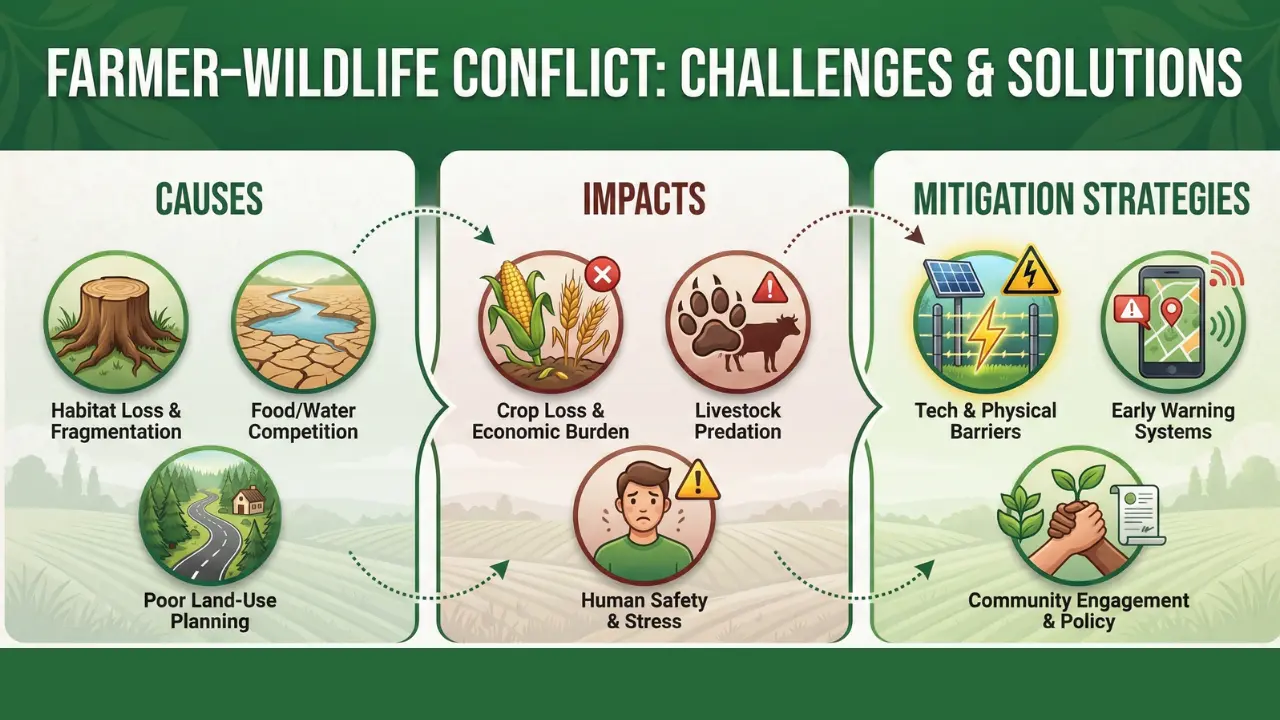
Habitat loss and fragmentation caused by agricultural expansion, deforestation, and infrastructure development reduce the availability of natural resources for wildlife. Fragmented habitats disrupt movement corridors, forcing animals to enter farmlands in search of food and shelter.
Competition for food and water is another major driver, particularly in regions facing seasonal droughts and ecological degradation. Crops with high nutritional value and easily accessible irrigation sources attract wildlife, increasing crop raiding incidents.
Poor land-use planning allows agriculture and settlements to expand into wildlife habitats and movement corridors. Weak wildlife management policies and climate change further intensify conflict by reducing natural food availability and increasing animal movement into farms.
Impacts Of Farmer–Wildlife Conflict
- Crop loss remains the most widespread and economically damaging impact, particularly for small and marginal farmers.
- Livestock predation by large carnivores results in financial losses and psychological stress.
- Human injuries and fatalities during crop guarding and grazing activities create fear and resentment toward conservation.
- Repeated losses force changes in agricultural practices, abandonment of farming, and rural-to-urban migration.
- The economic burden includes direct losses, guarding costs, and increased dependence on debt.
These pressures often lead to negative attitudes toward wildlife conservation.
Mitigation Strategies
Effective mitigation requires an integrated approach combining-
- Technological measures, physical barriers, community engagement, ecological restoration, and strong governance. Tools such as electric fencing, early warning systems, surveillance technologies, and mobile advisory services improve preparedness and response.
- Physical measures including fencing, trenches, watchtowers, and reinforced livestock enclosures reduce direct losses. Community-based platforms, participatory monitoring, and local communication systems strengthen coordination and trust.
- Restoration of habitats, building wildlife corridors, and water resources reduces wildlife dependence on farmlands.
- Governance interventions such as timely compensation, insurance schemes, infrastructure development, and community-based forest management are essential for long-term conflict reduction.
निष्कर्ष
Farmer–wildlife conflict is a complex issue shaped by ecological change, livelihood dependence, and development pressures. Integrated solutions that balance human needs with ecological integrity are essential. A coordinated, inclusive, and long-term approach offers the most effective pathway toward sustainable coexistence between farmers and wildlife.