According to a landmark report released by the Federation of Seed Industry of India in October 2024, weeds are responsible for an annual crop productivity loss of ₹92,000 crore ($11 billion) in India. This financial haemorrhage is primarily driven by the Weed Seed Bank, a hidden, persistent reservoir in the soil that sabotages crop yields.
Table of Contents
Explain Weed Seed Bank
The Weed Seed Bank refers to the reserve of viable weed seeds present on the soil surface and scattered throughout the soil profile. It serves as the primary source of future weed infestations, acting as a “biological memory” of past agricultural practices. The dynamics of the seed bank function like a financial bank:
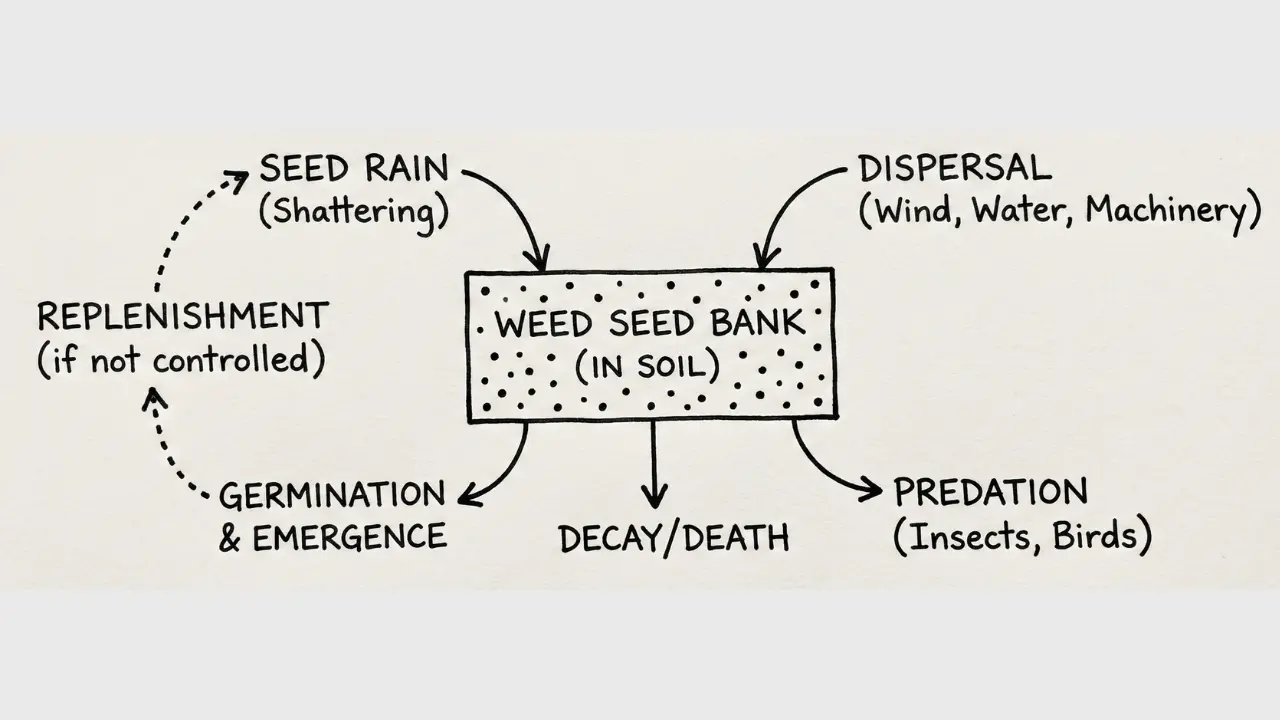
- Deposits: Added through “seed rain” (shattering of mature weeds), wind/water dispersal, and machinery.
- Withdrawals: Occur through germination, decay/death, and predation. Objective: To reduce the weed seed bank, management must focus on minimizing deposits (preventing seed set) and maximizing withdrawals (promoting germination or decay).
Strategies to Reduce Weed Seed Bank in Soil
A multi-pronged approach involving cultural, mechanical, biological, and chemical methods is required to deplete the seed bank effectively.
Cultural Strategies (Ecological Engineering)
- Stale Seedbed Technique: This is a highly effective method where the field is prepared/irrigated weeks before sowing the main crop to induce weed germination. The flushed weeds are then killed using shallow tillage or non-selective herbicides (e.g., Paraquat/Glyphosate). This depletes the “active” fraction of the seed bank.
- Soil Solarization: Covering the moist soil with transparent polyethylene sheets during peak summer (4-6 weeks) raises soil temperature by 10-12°C. This kills heat-sensitive weed seeds (e.g., फ़लारिस माइनर, अवेना फतुआ) and breaks dormancy of others, leading to fatal germination.
- Trap Cropping & Suicidal Germination:
- रोपण Trap Crops (e.g., Cotton or Soybean for Striga) stimulates weed seed germination via root exudates (e.g., strigolactones) but does not support their growth, effectively cleaning the soil.
- This is often termed “suicidal germination.”
- Crop Rotation: Rotating crops with different life cycles (e.g., legume-cereal rotation) disrupts the association of specific weeds with specific crops, preventing seed replenishment.
Mechanical and Physical Strategies
- Tillage Management:
- Deep Ploughing: Inverting soil puts seeds deep underground where they cannot germinate due to lack of light and oxygen (hypoxia), leading to eventual dormancy or death.
- Zero/Minimum Tillage: Keeps seeds on the surface where they are exposed to harsh weather (desiccation) and predators (ants/birds), reducing viability.
- Harvest Weed Seed Control (HWSC): A modern strategy to stop “deposits” during harvest.
- Seed Destructors: Attachments like the Harrington Seed Destructor crush weed seeds separated from the chaff during combine harvesting.
- Chaff Lining/Carting: Concentrating chaff (containing weed seeds) into narrow windrows to rot or burning it, preventing spread across the field.
Biological Strategies
- Seed Predation: enhancing populations of natural seed predators like Carabid beetles, crickets, ants, and rodents. Maintaining field margins and reducing broad-spectrum insecticide use can increase predation rates by up to 50%.
- Bio-herbicides: Application of fungal pathogens (mycoherbicides) to decay seeds in the soil.
Chemical Strategies
- Pre-emergence Herbicides: Application of chemicals like Pendimethalin या Atrazine kills weed seedlings immediately upon germination, preventing them from maturing and adding new seeds to the bank.
- Soil Fumigation: Using fumigants (e.g., Metham sodium) sterilizes the soil and kills weed seeds. Note: This is expensive and ecologicaly harsh, used mostly in high-value nurseries.
Prevention (Sanitation)
- Clean Seed: Using certified crop seeds free from weed seeds (e.g., avoiding Argemone seeds in mustard).
- Machinery Hygiene: Cleaning harvesters and tractors before moving between fields to prevent transporting seeds.
निष्कर्ष
Reducing the weed seed bank is a long-term investment in Sustainable Agriculture. Reliance on a single method often leads to resistance or species shifts. Therefore, an Integrated Weed Management (IWM) approach—combining the Stale Seedbed Technique with HWSC और फसल चक्र is the most effective strategy to exhaust the soil weed seed bank and ensure food security.