
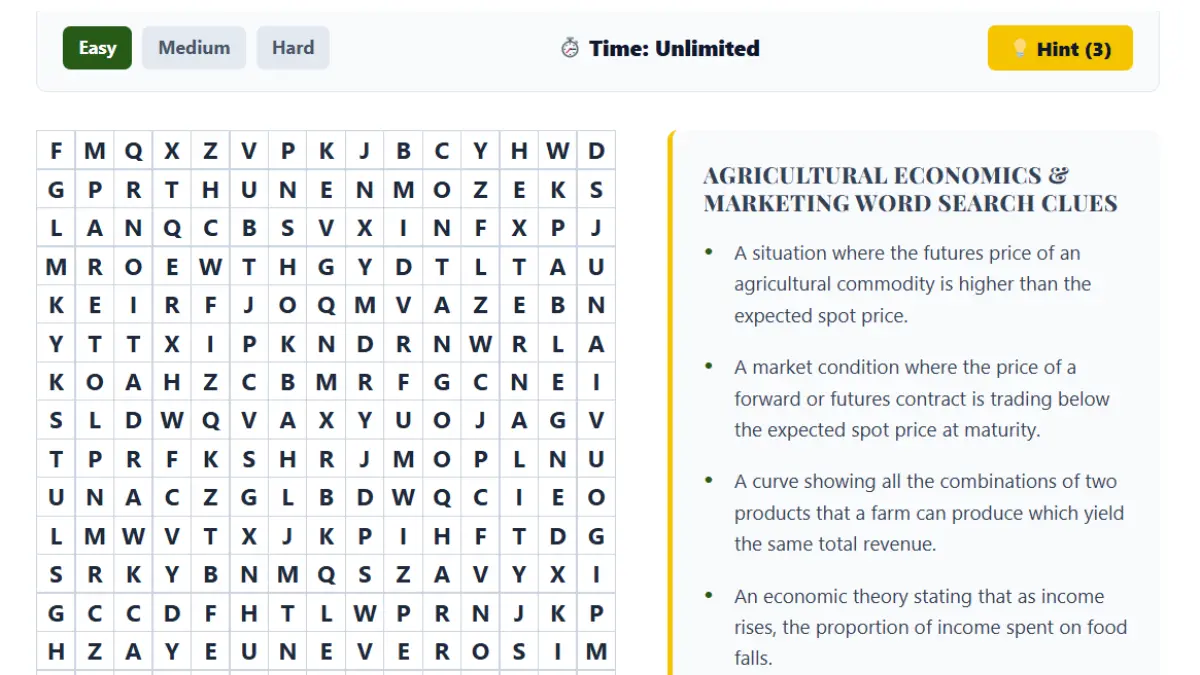
There are 12 agriculture science-related words from Agricultural Economics & Marketing subject hidden in this Agricultural Economics & Marketing word search game; try to read the clues and guess all of them. You can switch difficulty level to challenge yourself and improve your performance and skills.
Agricultural Economics & Marketing Word Search
Instructions: Test your knowledge with this interactive Agricultural Economics & Marketing Word Search puzzle. Select your difficulty, read the clues, and tap the first and last letters of the correct term to highlight it.
Agricultural Economics & Marketing Word Search Clues (12 Words)
- A situation where the futures price of an agricultural commodity is higher than the expected spot price.
- A market condition where the price of a forward or futures contract is trading below the expected spot price at maturity.
- A curve showing all the combinations of two products that a farm can produce which yield the same total revenue.
- An economic theory stating that as income rises, the proportion of income spent on food falls.
- An equation demonstrating how a change in price of an agricultural good affects demand, breaking it into substitution and income effects.
- A cost or benefit caused by a producer that is not financially incurred or received by that entity, such as pesticide runoff.
- An economic state where resources cannot be reallocated to make one individual better off without making at least one individual worse off.
- A production function implying strict complementarity of inputs without substitution, often utilized in agricultural input-output models.
- An economic model of land rent based on differing soil fertility and agricultural productivity across regions.
- An early spatial economic model explaining agricultural land use patterns based on transportation costs to a central market.
- An oligopoly model where agricultural firms compete on the amount of output they will produce, deciding independently and simultaneously.
- A tax assessed against private individuals or agribusinesses for engaging in activities that create adverse side effects for society.

How to Play Agriculture Review Agricultural Economics & Marketing Word Search?
Playing the We have designed Agriculture Review Agricultural Economics & Marketing Word Search to be intuitive but actively challenging your agricultural knowledge. Follow these simple steps to solve the grid:
- Choose Difficulty Level: You can start by selecting Easy, Medium, or Hard. Higher difficulties activate a countdown timer to test your quick-thinking skills under pressure.
- Read the Clues: Instead of simple words, you will be given academic definitions, hints, or clues. Try to identify the correct terminology based on the provided clue.
- Scan the Grid: Target words can be placed horizontally, vertically, forwards, or backwards within the 12×12 grid.
- Highlight Your Answer: For a mobile-friendly experience, simply tap the first letter of the word, then tap the last letter. The game will automatically highlight the word.
- Use Hints Wisely: If you are stuck on a difficult term? Click the Hint button to reveal a pulsating golden highlight on the first letter of an unfound word. You only get three hints per game!
Benefits of Playing Our Agriculture Word Search
This isn’t just a casual puzzle; it is a well structured educational tool built for serious agriculture students, graduates, and professionals. Here is how it helps you study:
🧠 Active Recall Practice
By matching complex definitions to specific terminology, you transition from passive reading to active cognitive recall, drastically improving long-term memory retention.
📚 Exam Preparation
Familiarizing yourself with key terms across agronomy, plant pathology, and Agricultural Economics & Marketing helps build the foundational vocabulary needed for competitive graduate-level exams.
⏱️ Time Management
Utilizing the Medium or Hard timer difficulties trains your brain to process agricultural information quickly and accurately under strict time constraints.
📱 Interactive Learning
Breaking up traditional textbook study sessions with an engaging, interactive format prevents burnout and keeps the learning process fresh and enjoyable.


