

Whatever newspaper you read or watch news bulletins from, cautions regarding misuse of antibiotics seem trending. Misuse is driving a dangerous surge in antimicrobial resistance, threatening global health and making common infections harder to treat. Due to busy schedules, workloads, and overreliance on allopathic medicines, people have forgotten to take a break and heal naturally even for the simplest cough & cold. Results are evident: “Antimicrobial Resistance.”
But how are antibiotics related to farming, and should we use them? Is there a safe limit, and what does the World Health Organization recommend? Before understanding whether we should use antibiotics in farming or not, we should know what antibiotics are and why health experts are concerned about their use.
What are antibiotics?
According to the Food and Agriculture Organization (FAO), “antibiotics are drugs of natural or synthetic origin that have the capacity to kill or to inhibit the growth of microorganisms. They act as chemotherapeutic agents to treat infections in humans, animals, and crops.
But if they kill micro-organisms, then what’s the big deal? It’s a win-win situation, right… Well no, that’s where we have to understand the term “antimicrobial resistance.”
What’s Antimicrobial Resistance?
You might have heard the term “survival of the fittest” or “adaptation” or “mutation.” Something similar happens in microorganisms when antibiotics are misused. Antimicrobial resistance is the ability of microorganisms to survive or multiply when exposed to concentrations of an antimicrobial drug that would normally kill or inhibit them. Recent World Health Organization data shows that roughly 1 in 6 confirmed bacterial infections worldwide were resistant to antibiotics.
Due to antimicrobial resistance, diseases such as tuberculosis, gonorrhea, etc. are becoming harder to treat, and it is directly responsible for over 1 million global deaths annually.
Should Antibiotics Be Used In Farming?
Agriculture (livestock and crops) accounts for around 70% to 80% of the global antibiotic consumption, causing a serious alarming situation. According to the assessments by the NIH, 75% to 90% of antibiotics administered to farm animals are excreted unmetabolized, directly polluting surrounding soil and local waterways. Furthermore, mass overuse of antibiotics in agriculture creates ideal evolutionary conditions for drug-resistant bacteria (superbugs).
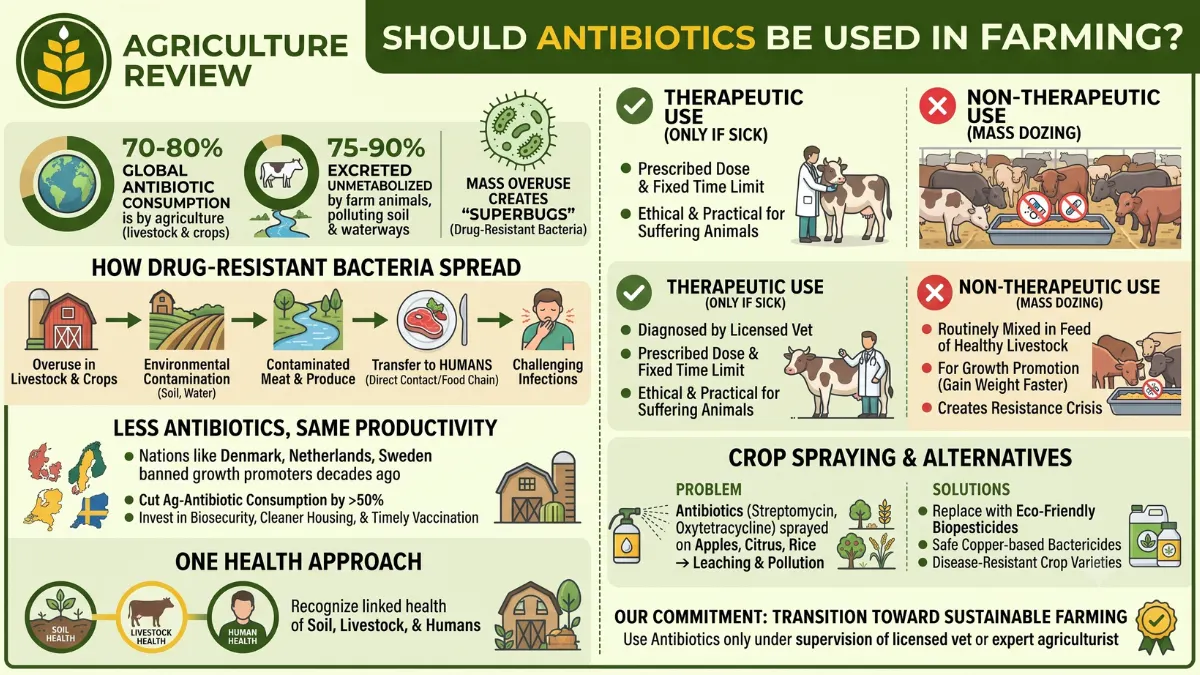
These antibiotic-resistant bacteria could transfer to humans via direct contact, the environment, or the food chain through contaminated meat and other produce, hence making it more challenging. The antibiotic era that first emerged (1910) with the discovery of the first known antibiotic, Salvarsan, and then penicillin by Alexander Fleming, and now its use has become widespread. This is not simply a worldwide public health issue; rather, it will also have an impact on animal health, food security, and the environment.
But, despite that, should antibiotics be used in farming? The simple answer is to use it with caution and not like a daily dose of some wonder medicine. Just like humans, farm animals get sick, and we can’t deny a life-saving drug to a suffering animal; that’s neither ethical nor practical. Antibiotics are undeniably necessary when used therapeutically. It should be used exclusively to treat sick animals diagnosed by a licensed veterinarian by following a prescribed dose for a fixed time limit.
The crisis primarily stems from non-therapeutic use when farmers routinely mix sub-therapeutic doses of antibiotics into the daily feed of healthy livestock just to make them gain weight faster. Nations like Denmark, the Netherlands, and Sweden banned antibiotic growth promoters decades ago and proved that investing in farm biosecurity, cleaner animal housing, and timely vaccination can cut agricultural antibiotic consumption by over 50%.
Farmers spray antibiotics like streptomycin and oxytetracycline on crops to treat bacterial infections in apples, citrus fruits, and rice. Overuse results in leaching, which contaminates soil and water bodies. The most sustainable alternative is replacing these antibiotics with eco-friendly biopesticides, safe copper-based bactericides, and disease-resistant crop varieties.
Ultimately, the debate is not about eliminating antibiotics from agriculture but about reserving them strictly as a cure rather than a crutch. The escalating crisis of antimicrobial resistance demands a “One Health” approach; we should recognize that the health of our soil, our livestock, and our human population is inseparably linked. To overcome this crisis, we should take a pledge to transition towards sustainable agriculture and use antibiotics only under the supervision and guidance of an expert agriculturist or a licensed veterinarian for a safe, healthy, and better future of agriculture.