India stands at an important point in its agricultural journey. Over the last few decades, the country has made remarkable progress in food production, emerging as one of the world’s largest producers of cereals, fruits and vegetables. The challenge before us today, however, is no longer limited to producing more. It is about producing better.
With shrinking landholdings, rising labour costs, climate uncertainty and increasing pressure on natural resources, the future of Indian agriculture will depend on how efficiently we use every acre of land, every litre of water and every hour spent on the farm. In this changing landscape, practical farm equipment such as the Power Weeder will play an increasingly important role in helping farmers improve productivity while protecting soil health and using resources more efficiently.
This is why I believe the conversation around farm mechanisation needs to evolve. For years, mechanisation was largely seen as a way to reduce manual labour. While that remains important, its role today is much larger. The right farm equipment allows farmers to complete critical operations on time, improve soil conditions, conserve resources and ultimately grow healthier crops. In many ways, mechanisation has become as much about improving productivity as it is about improving sustainability.
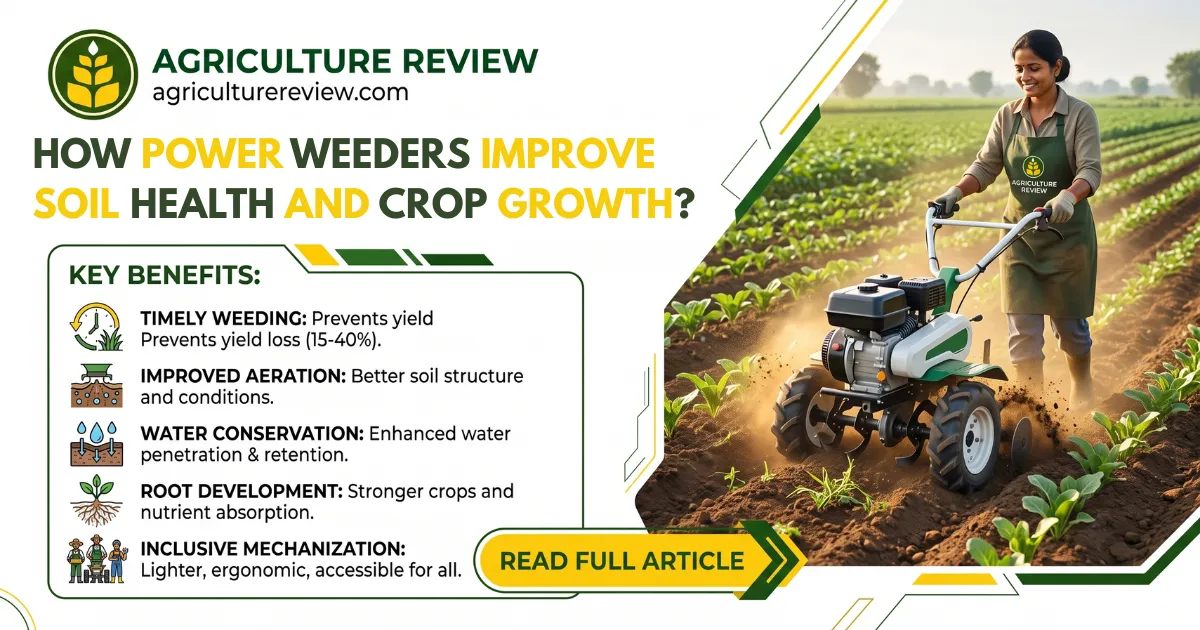
One of the clearest examples of this is weed management. Weeding is often treated as a routine farm activity, but its impact on crop health is significant. Weeds compete with crops for water, nutrients and sunlight, and studies show that unchecked weed growth can reduce crop yields by 15 to 40 percent. Yet this is also one of the operations most affected by labour shortages. Farmers may know exactly when a field needs to be weeded, but finding workers during peak agricultural seasons is becoming increasingly difficult. By the time the work is completed, crops have often already lost valuable growth.
In my view, this is where mechanisation delivers its greatest value. A Power Weeder is not simply a machine that removes weeds faster. It enables farmers to carry out a critical farm operation when it needs to be done, rather than when labour becomes available. That may sound like a small difference, but in agriculture, timely intervention often determines the outcome of an entire season.
There is another benefit that deserves far more attention. As it helps loosen the top layer of soil between crop rows, they improve aeration and allow water to penetrate more effectively. This creates better conditions for root development and nutrient absorption while reducing moisture loss from the soil. Farmers often focus on what happens above the ground, but healthy crops always begin below the surface. Better soil structure supports stronger plant growth while improving the long-term productivity of the land. Better aeration and moisture retention also help crops develop stronger root systems, enabling them to absorb nutrients more efficiently. Over time, this leads to healthier plant growth, improved resilience and more consistent yields.
I believe soil health is no longer just an environmental concern. It is becoming an economic one. Healthy soil retains moisture, supports beneficial microorganisms and improves the efficiency of fertilisers. Over time, this helps farmers reduce cultivation costs while sustaining productivity. As climate conditions become increasingly unpredictable, protecting soil health will be just as important as investing in better seeds or irrigation systems.
India also needs to build its own approach to mechanisation. We cannot simply replicate farming models from countries where large tractors operate across hundreds of acres. Nearly 86 percent of Indian farmers are small and marginal landholders. Their challenges are different, and so are their requirements. They need machines that are compact, affordable, fuel efficient and versatile enough to work in smaller fields.
Countries such as Japan and South Korea recognised this years ago and focused on developing lightweight farm equipment suited to fragmented landholdings. India is now moving in the same direction, and I believe this is exactly where innovation should be focused.
One development that gives me particular confidence is the growing emphasis on inclusive mechanisation.
Women contribute significantly to India’s agricultural workforce, yet farm equipment has traditionally been designed without considering their needs. Today, lighter, more ergonomic machines are making mechanisation more accessible. Research by ICAR has shown that ergonomically designed weeders can significantly reduce operator fatigue. This is not just about comfort. It is about enabling more people within a farming household to operate machinery confidently and contribute to farm productivity.
Agriculture continues to support millions of livelihoods and remains central to India’s economic growth. If India is to achieve its ambition of becoming a developed economy, improving farm productivity must remain a national priority. This cannot be achieved through policy alone. It requires practical technologies that solve everyday challenges on the ground while protecting the country’s most valuable natural resource; its soil.
These machines may not attract the same attention as larger farm equipment, but their contribution extends far beyond weed control. They improve soil health, help conserve water, support healthier crops and reduce dependence on scarce labour. More importantly, they represent the direction in which Indian agriculture needs to move. The future will not belong to the biggest machines. It will belong to the smartest solutions that help farmers produce more, use resources wisely and build healthier farms for the long term.