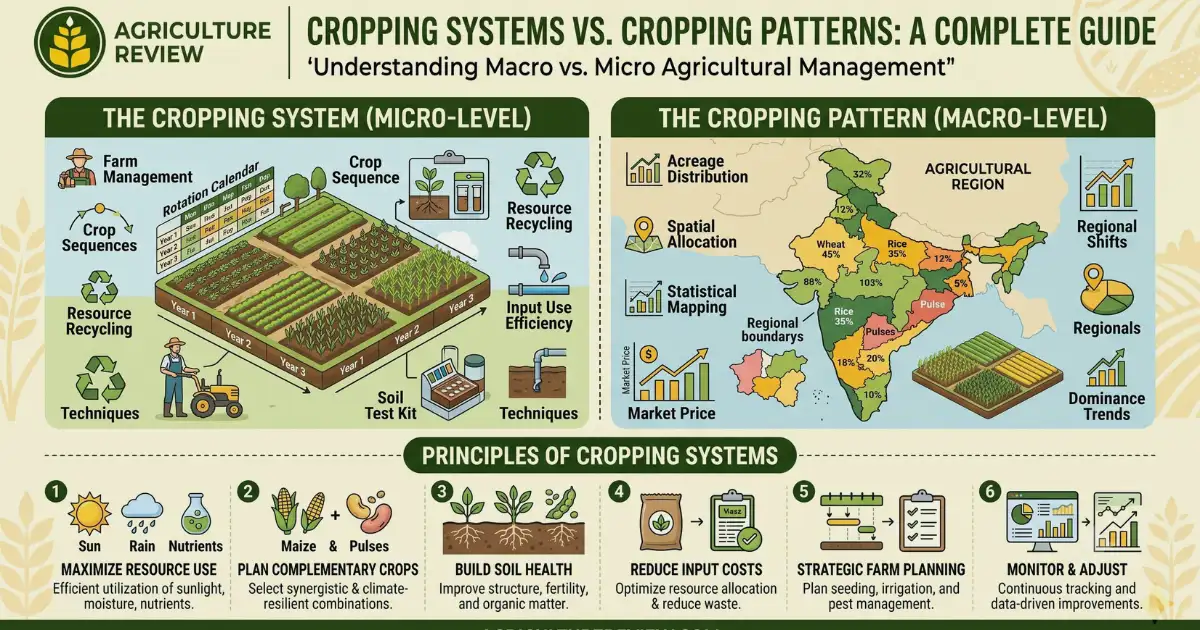

अं cropping system refers to the crop and crop sequences and the management techniques used on a particular field over a period of years, while a cropping pattern refers to the proportion of area under different crops at different points in time.
Difference Between Cropping System and Cropping Pattern
| विशेषताएँ | फसल प्रणाली | Cropping Pattern |
|---|---|---|
| 1. Meaning | Refers to the combination of crops and the complete management practices used on a farm over a period. | Refers to the spatial and temporal distribution of land under different crops at a given point in a specific area. |
| 2. Scope | Broader; includes internal interactions, resource recycling, and input management (fertilizer, irrigation). | Narrower; purely represents the geographical and statistical mapping of crop acreage. |
| 3. Primary Focus | Sustainability, long-term soil health, and maximizing output-use efficiency. | Area allocation, crop intensity, and identifies shifts in crop dominance. |
| 4. Scale | Micro-level; designed and implemented at the individual farm or field level. | Macro-level; analyzed at the regional, state, or national level (e.g., state acreage map). |
| 5. Components | Interconnected components: Crops + Soil + Management + Capital + Technology + Livestock (if any). | A single component: Crops on geographical land. |
| 6. Objective | To maximize sustainable net returns while mitigating risk and conserving natural resources. | To provide a statistical overview of a region’s current agricultural land utilization. |
| 7. Dynamism | Highly dynamic; a farmer can change inputs or crop sequences easily from season to season. | Relatively static; regional shifts in crop patterns take many years, driven by policy or market trends. |
| 8. Key Determinants | Farm resources, labor availability, technological access, and micro-climate. | Geographical factors, macro-economic demand, and government policies (MSP, subsidies). |
| 9. Resource Interaction | Focuses on biological synergies (e.g., nitrogen fixation by legumes in a sequence). | Focuses on spatial arrangement (are crops competitive, supplementary, or dominant?). |
| 10. Examples | Maize-Wheat system using zero tillage; Rice-Pulses sequence for nutrient efficiency. | State of Uttar Pradesh: 65% area Rice, 25% Sugarcane, 10% Pulses. |
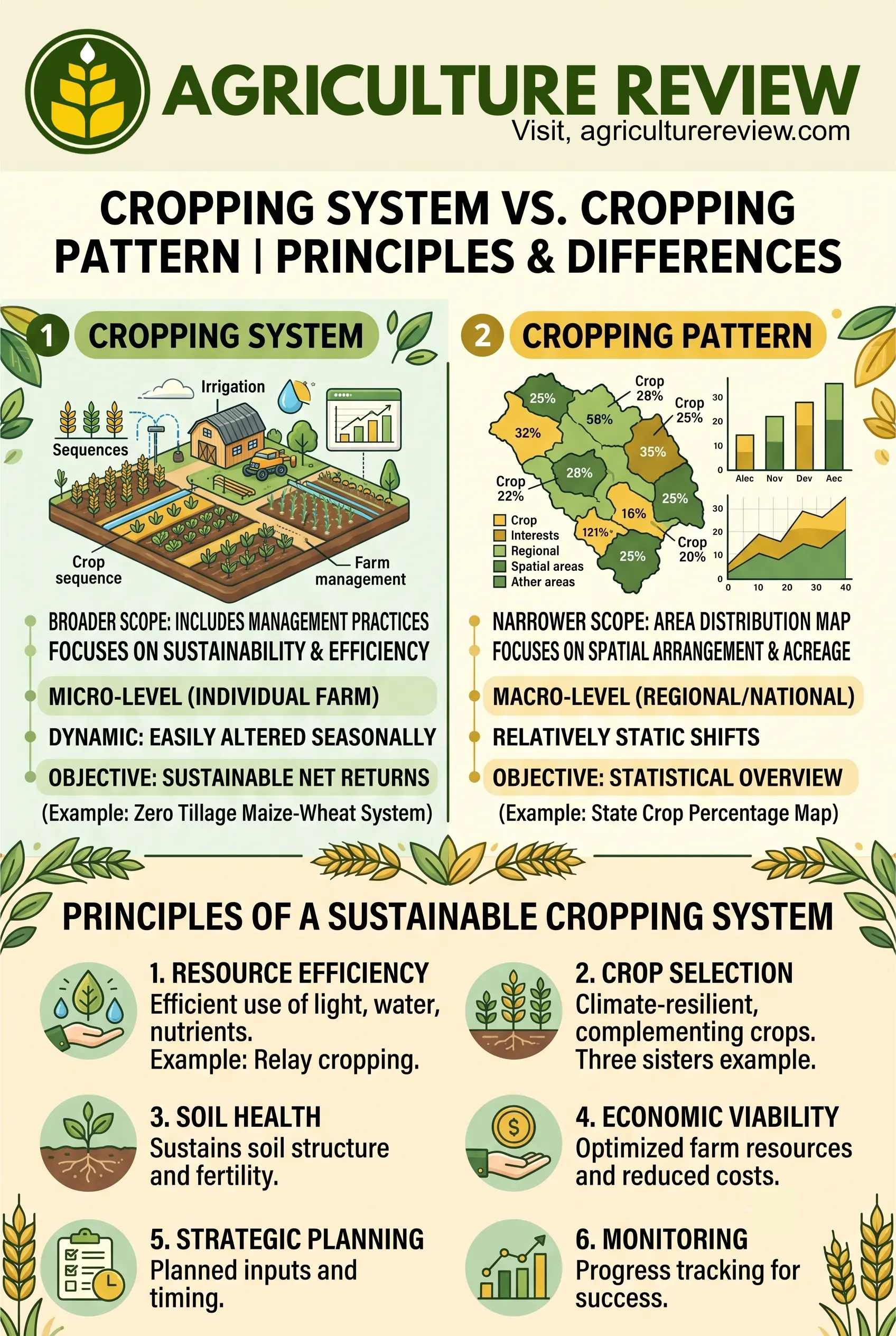
Principles Of Cropping System
- Resource Efficiency: Efficient utilization of solar radiation, moisture, and soil nutrients and other farm inputs through temporal and spatial arrangements. Example: relay cropping.
- Crop Selection: Select crops that complement each other and are climate resilient. Example: Three sisters’ plantation of corn, squash, and beans.
- Soil Health: Selection of crops and cropping system that sustain soil health.
- Economic Viability: By reducing costs of farm inputs and optimizing year-round employment of farm resources.
- Strategic Planning: Planned seed selection, sowing time and method, irrigation, fertilizer use and pest and disease management improve overall productivity.
- Monitoring: Keep monitoring progress for avoiding any mishap.
While scientifically sound cropping systems ensure resource-efficient और climate-resilient agriculture, the way forward demands aligning macro-level cropping patterns with agro-ecological zones. This integrated approach, driven by policy-backed diversification, is vital to boost farmers’ incomes and achieve long-term food security in line with SDGs.
हमारे विशाल कृषि समुदाय से जुड़ें!
अपडेट, स्टडी गाइड और रोज़ाना की चर्चाओं के लिए हज़ारों अन्य लोगों से जुड़ें।
👥 271K+ ग्रुप सदस्य
👍 20K+ FB फ़ॉलोअर्स
📸 2K+ IG फ़ॉलोअर्स
📢 1,600+ चैनल सदस्य